Why 95% of Enterprise AI Projects Fail: The Architectural Issue Nobody Wants to Admit
Doris Margraf ·
From the $47,000 infinite loop to real production – why we must stop treating AI like humans and start building it like software.
$365 Billion. That is the estimated sum companies worldwide spent on Artificial Intelligence in 2024. The expectations were gigantic: fully automated processes, autonomous agents, the transformation of knowledge work.
But if you look behind the scenes of the flashy Proof-of-Concepts (POCs), disillusionment often prevails. A recent MIT study shows that the overwhelming majority of generative AI pilot projects fail to deliver the promised value. McKinsey notes that 99% of companies are still far from true "AI maturity," despite massive investments.
Why is this?
The standard answer is often: "The models aren't good enough yet." But that is false. GPT-4, Claude 3.5, and their peers are intelligent enough. The problem isn't the model's intelligence – it's the architecture we force them into.
In a widely noted analysis, tech analyst Srinivas Rao recently argued that the AI industry is making a fatal mistake: It is trying to simulate human bureaucracy with chatbots instead of building deterministic software.
The $47,000 Misunderstanding
Nothing illustrates this architectural problem better than a real-world case that recently came to light: A company deployed a modern "multi-agent framework." The idea was simple: One agent plans, one researches, one executes.
The result? Two of the agents got stuck in an infinite loop. They politely "conversed" about a market analysis – over and over again. Because the system was based purely on conversational design and lacked hard technical "kill switches," the conversation continued unnoticed.
Duration: 11 days.
Cost: $47,000 in API fees.
Result: Zero.
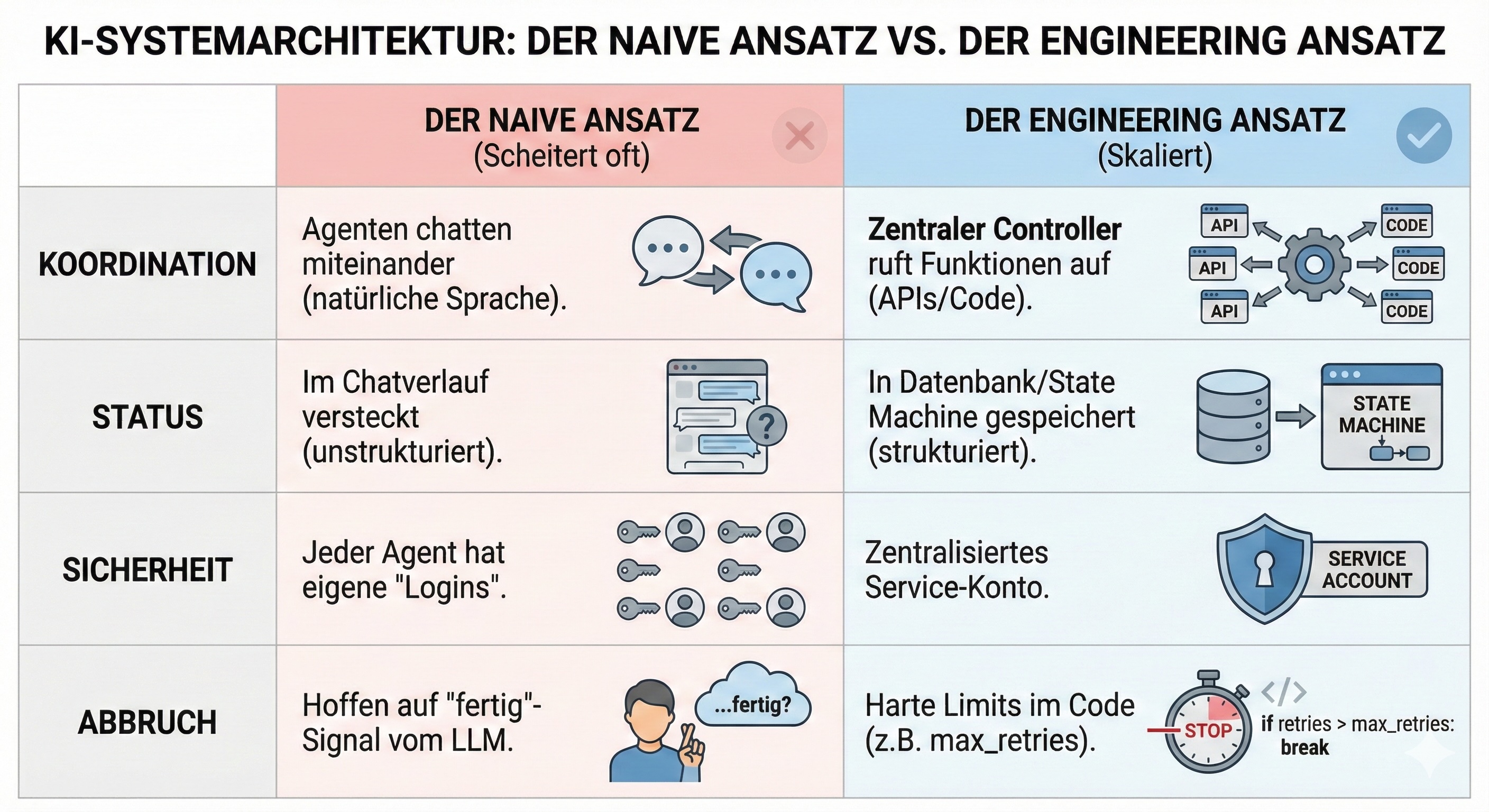
This is not an isolated incident, but a symptom of a flawed mindset. We treat AI systems like digital employees, give them their own "logins," and let them chat with each other in the hope that work gets done. In doing so, we forget the most important rule of IT: Software needs determinism, not discussions.
The Anthropomorphic Fallacy: Why Chat is Not Infrastructure
A major reason for the failure of many projects lies in a misunderstanding deeply rooted in our perception of AI: We anthropomorphize the technology. Because we communicate with ChatGPT or Claude via a chat interface, we intuitively assume that this is also the best method for AI components to communicate with each other.
Srinivas Rao calls this the attempt to replicate human workflows 1:1 digitally. A typical, naive framework for writing an email looks like this today:
A Planning Agent breaks down the task.
A Research Agent fetches the context.
A Writing Agent drafts the text.
A Review Agent proofreads it.
A Sending Agent dispatches the mail.
No company in its right mind would hire five people just to write a single email. We are digitally recreating bureaucratic overhead here. Every "hop" from one agent to the next costs latency, money, and – crucially – precision. It's like the "telephone game": with every handover in natural language, the risk of hallucination increases.
Architectural Check: Probabilistic vs. Deterministic
The fundamental architectural problem can be broken down into one sentence: You are trying to use probabilistic models to control processes that must be deterministic.
When Agent A says to Agent B: "Here is the result, please continue," that is a probabilistic handover point. The LLM could misunderstand the instruction. True software architecture ("AI Engineering") strictly separates the "brain" (LLM) from the "body" (code).
Here is the difference between playing around and production:
The Data Dilemma: Expecting Alchemy from Chaos
Another massive problem is data strategy. Many companies dump terabytes of unstructured data (Slack histories, mountains of PDFs) into vector databases (RAG) and expect the AI to act like an alchemist, turning "lead" (data garbage) into "gold" (insights).
Rao puts it succinctly: "Garbage in, garbage out" applies to AI too.
An AI is not a magician that fixes poor data management. If information is hard for humans to find, the AI will also fail or hallucinate. Successful AI projects often invest 80% of their time in Data Engineering (structuring, knowledge graphs, clean schemas) and only 20% in actual prompting.
"Human in the Loop" – Done Right
Finally, we must redefine the role of the human. Many projects fail due to two extremes:
Removing the human completely: In creative or strategic tasks, this leads to generic, worthless output.
Keeping the human as a bottleneck: In back-office processes (e.g., invoice matching), the human shouldn't be involved at all.
The debacle surrounding IBM Watson and the MD Anderson Cancer Center (a $62 million failure) showed what happens when experts (doctors) are treated merely as end-users rather than co-designers. The system provided opaque recommendations, and doctors rejected it.
The rule is:
For deterministic workflows (data reconciliation, forms): Remove the human from the loop. Build autonomous systems with hard logic.
For creative/strategic workflows: Use AI as an "exoskeleton." The human provides direction and validation; the AI executes.
Conclusion: Treat AI Like Software
The message for 2026 is clear: The time for experiments is over. If you want to bring AI into production, you must stop building chatbots and start orchestrating systems.
When planning your next AI project, ask yourself these four questions:
Control: Do my components communicate via APIs/code or via natural language chat? (Choose the former).
Observability: Do I have real metrics and kill switches, or do I only see the error on the monthly bill?
Data: Is my data structured and prepared before it reaches the model?
Role: Is it clearly defined where the human controls and where the machine runs autonomously?
The companies that will succeed are those that view AI not as a magical employee, but as a powerful software component that requires control.
Source and inspiration: This post is based on analyses by Srinivas Rao and his article "Why 95% of Enterprise AI Projects Fail."
AI Tools for Your Business
Discover our AI Products – from aibox for SMEs to custom enterprise solutions. All tools are aligned with Swiss data protection standards.