Vibe Coding 2025: Vision over Syntax – A Reality Check on the 'Insurance Assistant' Project
Jens Margraf ·
Vibe Coding transforms software development. This article tests Lovable, Google AI Studio, and ChatGPT 5.2 building an AI insurance assistant.
The year 2025 has radically transformed software development. But how effective is the hype around 'Vibe Coding' when building a complex project like an AI-powered insurance assistant? I put Lovable, Google AI Studio, and ChatGPT 5.2 to the test. Here's my experience report on power, costs, and user-friendliness.
What exactly is Vibe Coding?
Early 2025 marked the breakthrough of Vibe Coding. Developers no longer laboriously write line by line, but rather describe the 'vibes' – the intention, the experience, and the logic. AI agents then handle the implementation. In theory, anyone can become a software creator this way. In practice, however, significant differences in the 'altitude' of the tools emerge.
The Stress Test: Three Paths to the 'Insurance Assistant'
My goal: a Smart Gap-Finder that analyzes insurance policies (PDFs), identifies coverage gaps, and offers the user an attractive dashboard for optimization.
1. Lovable: The 'All-in-One' Champion for Makers
By 2025, Lovable had established itself as the go-to tool for anyone who wants a finished app without delving deep into the tech.
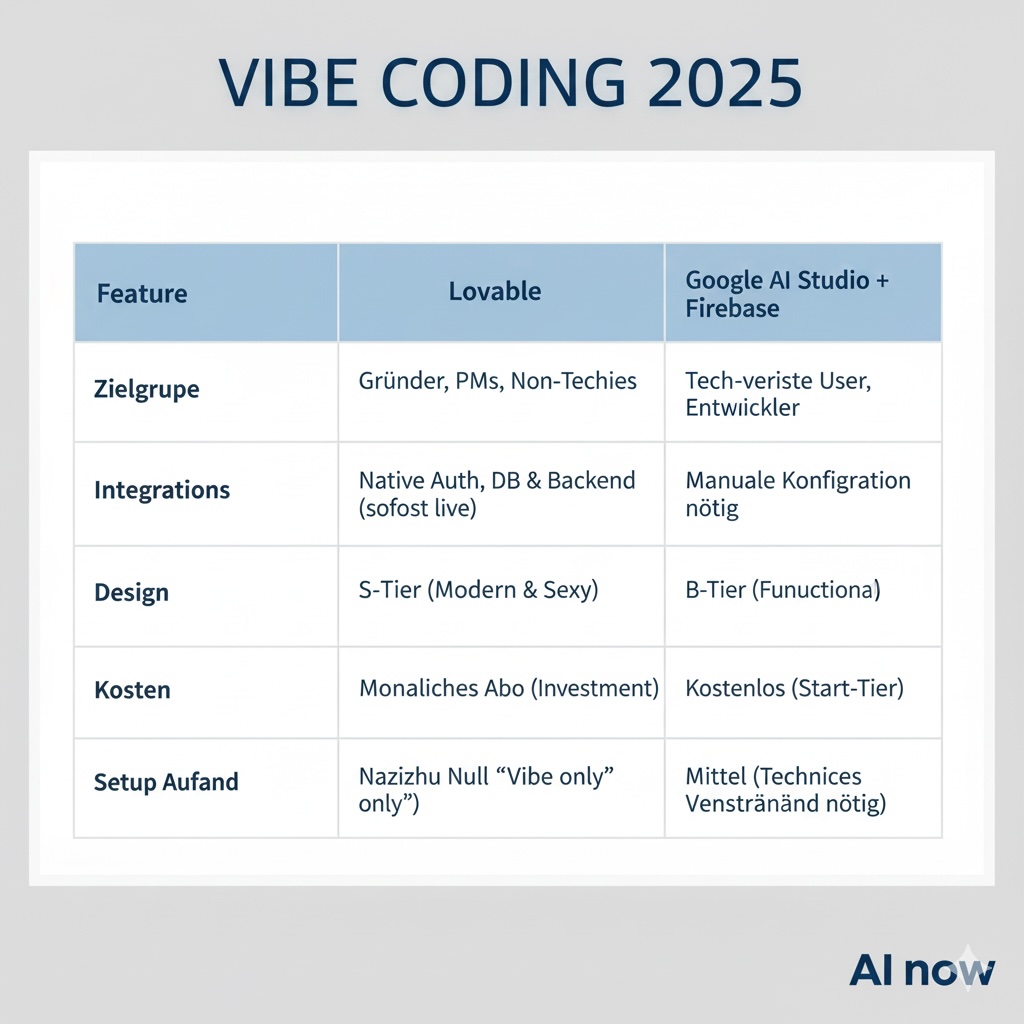
The Experience: Lovable delivers not just code, but a complete ecosystem. Thanks to native integrations (like Supabase for the database or Stripe for payments), the authentication process (login/signup) was ready in seconds.
Advantage: It's an 'all-round carefree solution'. Frontend, backend, and hosting come from a single source. For the less tech-savvy user, it's the fastest shortcut to market launch.
Investment: This comfort is an investment (Pro plans starting from around $25/month). You pay for the enormous time savings and the professional UI that looks 'out-of-the-box' like high-end SaaS.
2. Google AI Studio + Firebase: The Technical Powerhouse
Google, with its combination of Gemini 3 and Firebase (now unified as 'Firebase Studio'), offers the most powerful free foundation.
The Experience: Here, you build a technically highly sophisticated prototype. It feels 'more real' because you have direct access to Google's cloud infrastructure. Gemini's context window effortlessly processes hundreds of pages of insurance jargon.
Advantage: It's free (in the standard tiers) and offers maximum technical freedom. If you know what a database structure is, you can build extremely profound logic here.
Disadvantage: The UI is functional but often appears 'engineer-driven'. You have to invest significantly more effort to make the app as attractive as with Lovable. It is the tool for the more technically savvy user.
3. ChatGPT 5.2: The Architect at its Limit
ChatGPT functioned as the 'strategic brain' in my project.
The Experience: Unbeatable for solving complex logic problems (e.g., 'How do we compare blanket coverage with an itemized listing?').
The Limit: Designed as a pure code architect, the model eventually got stuck with very large, coherent structures. ChatGPT is the perfect advisor for partial components, but (yet) not an autonomous full-stack developer for the entire project.
My Conclusion: Time vs. Money?
Vibe Coding in 2025 is not a question of 'whether', but 'how'.
For my Insurance Assistant, the realization was clear: if I quickly need an attractive, fully functional app with login and user management, Lovable is worth every penny. It turns an idea into a product.
However, if you're looking for technical depth, want to analyze large amounts of data, and are willing to 'look under the hood' yourself, Google AI Studio offers an unbeatable, free power tool.
The 'AI now' strategy: Start with Lovable for a quick market test (MVP) and use Google AI Studio as the engine for the tough data challenges. This way, you combine the best of both worlds.
What's your vibe? Do you prefer the fast all-in-one solution, or do you prefer to build technically deep with Google?
AI Tools for Your Business
Discover our AI Products – from aibox for SMEs to custom enterprise solutions. All tools are aligned with Swiss data protection standards.