Why Google’s "Project Genie" Reaches Far Beyond Gaming
Jens Margraf ·
Imagine uploading a photo of a napkin sketch and, seconds later, walking through that world in 3D—with accurate physics and in real-time. What sounds like science fiction became a reality with Google DeepMind’s launch of Project Genie. We analyze why the gaming industry is trembling and how interactive "World Models" are about to revolutionize everything from "Vibe Coding" to autonomous driving and robotics.
1. The Breakthrough: Google’s First True "World Model"
In early February 2026, Google DeepMind granted AI Ultra subscribers access to the research prototype Project Genie(powered by Genie 3). This isn't just another video generator like Sora; it is a fundamental leap in how AI perceives and constructs space.
From Passive to Active: Unlike video AI, Genie generates interactive environments at 24 FPS.
Controllability: Users can navigate characters through the generated space, with the AI maintaining consistent 3D geometry and "on-the-fly" physics.
The Engine: A sophisticated interplay between the world model Genie 3, the high-fidelity texture model Nano Banana Pro, and the reasoning capabilities of Gemini.
2. A Seismic Shift in the Gaming Industry
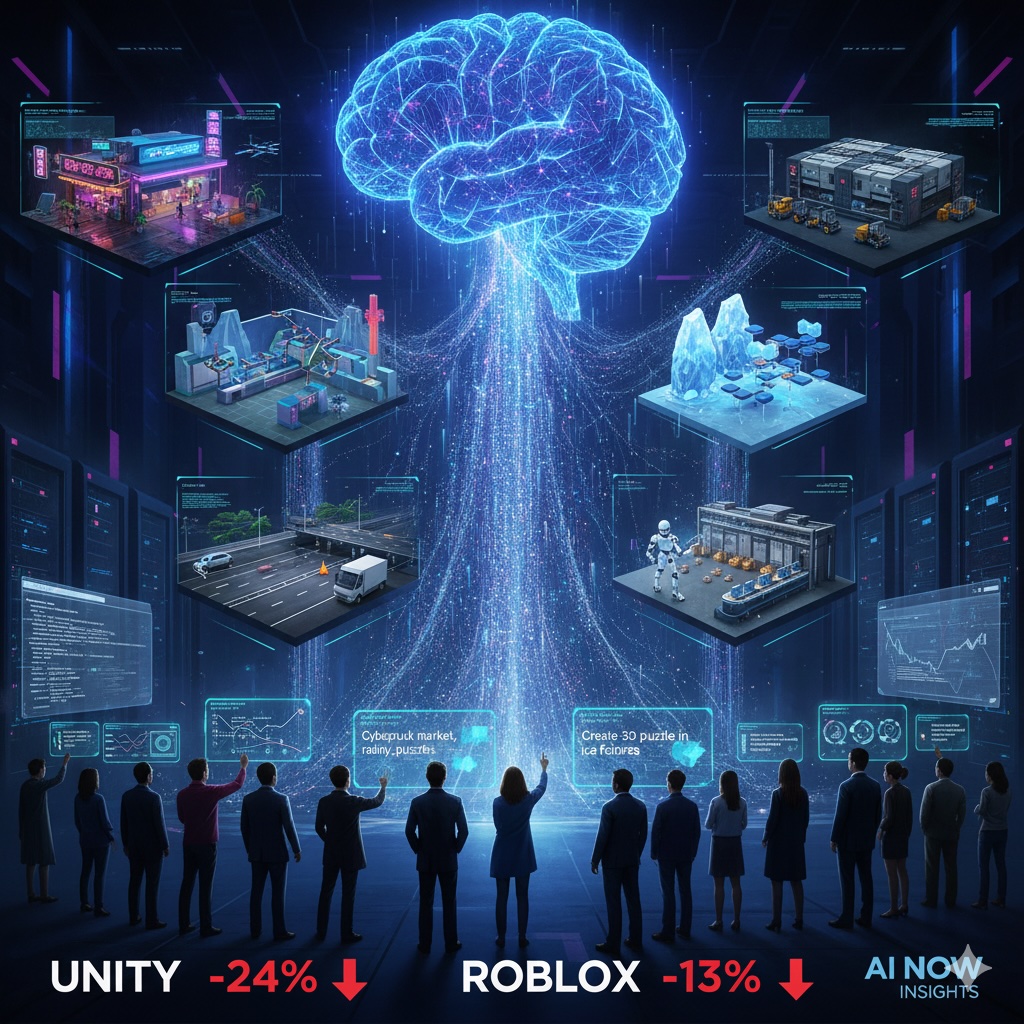
The market reaction was swift. Immediately following the announcement, stock prices for industry giants plummeted: Unity (-24%) and Roblox (-13%) saw massive sell-offs.
The End of Asset-Heavy Development? Investors fear that traditional game engines and expensive 3D asset pipelines might become obsolete if environments can be "dreamt up" instantly.
Vibe Coding 2.0: With tools like Lovable, the barrier to entry is vanishing. "Vibe Coding"—where you describe the aesthetic and mechanics rather than writing code—is turning creators into curators. A single person can now envision and deploy a 3D world that previously required a team of fifty.
3. Beyond the Screen: Simulation, Robotics, and Auto
The true power of Genie 3 lies not in entertainment, but in its application as a universal simulator for the physical world:
Autonomous Driving: Instead of logging millions of miles on real roads, companies like Waymo or Tesla can use Genie to simulate infinite "edge cases"—like a child darting between cars during a blizzard—safely and instantly.
Embodied AI & Robotics: Humanoid robots (e.g., from 1X or Figure) need to learn how objects behave. In an AI-generated 3D world, they can perform millions of grasping and movement trials in hyper-speed before ever stepping onto a factory floor.
Industrial Digital Twins: Engineers can "prompt" entire logistics centers into existence to test layout efficiency and stress-test supply chains in a real-time, interactive 3D environment.
4. The Competitive Landscape: The Race for "Physical AI"
Google isn't alone. 2026 has become the year of the "World Model" wars:
OpenAI: Still refining Sora to achieve the same level of real-time interactivity Google has showcased.
NVIDIA: Positioning its Alpamayo platform as the essential hardware infrastructure for these massive simulations.
World Labs: The unicorn founded by Fei-Fei Li is attacking Google directly with Marble, a model designed for persistent, high-fidelity 3D spatial intelligence.
5. Conclusion: AI Gets "Hands and Feet"
We are witnessing the transition from AI that talks to AI that understands and simulates reality. Project Genie is the bridge between digital intelligence and physical execution. Whether you are a gamer, a coder, or an industrial engineer, the message is clear: The next decade won't be about building worlds—it will be about prompting them.