EU AI Act for Swiss SaaS Providers: The 2026 Practice Guide
Jens Margraf ·
Swiss SaaS providers in the EU market: What the EU AI Act 2026 means for providers like aibox – obligations, checklist and legal certainty for Germany.
Most Swiss SaaS providers selling to Germany today operate in a regulatory grey zone – without knowing it.
Not because their technology is poor. But because between launching a platform and signing the first German enterprise customer, there is a compliance gap that hardly anyone has on their radar: the EU AI Act (Regulation EU 2024/1689).
For platforms like aibox-app.ch, which gives Swiss companies access to the most powerful language models – from ChatGPT to Claude to Perplexity – this is not an abstract threat. It is the new reality of exporting into the EU market.
This guide explains what Swiss SaaS providers need to do right now.
What is the EU AI Act – and why does it apply to Swiss companies?
The EU AI Act has been in force since August 1, 2024 and is being applied in stages:
February 2025: Prohibited AI practices came into force
August 2025: Transparency and documentation obligations for GPAI models (General Purpose AI)
August 2026: Full requirements for high-risk AI systems
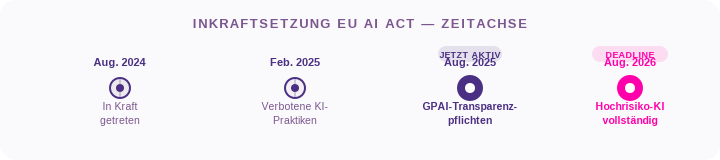
Crucial for Swiss providers: The AI Act has extraterritorial effect. Anyone offering AI services on the EU market – regardless of company headquarters – falls within its scope. Swiss SaaS providers with German customers are just as affected as Berlin-based startups.
The AI Act has extraterritorial effect. Anyone offering AI services on the EU market – regardless of company headquarters – falls within its scope.
The three roles in the EU AI Act: Who bears which responsibility?
The AI Act does not think in terms of "providers" and "users." It thinks in chains of responsibility. For Swiss SaaS providers, the distinction between these three roles is critical:
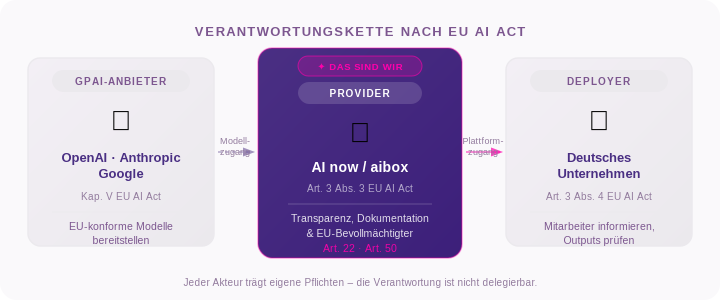
Us as "Provider" (Art. 3 Para. 3 EU AI Act)
Even those who do not train language models themselves are considered providers – as soon as an application is made available on the EU market under their own name. As an aibox provider, we are responsible for safety standards, transparency and technical documentation.
The German customer as "Deployer" (Art. 3 Para. 4 EU AI Act)
A deployer is not a passive user. A marketing agency in Munich that generates client texts via aibox carries its own legal obligations: It must inform employees that they are interacting with AI and review outputs for accuracy. Providers who fail to communicate this leave their customers legally exposed.
OpenAI, Anthropic & Google as "GPAI Providers" (Chapter V EU AI Act)
The language models in the background fall under GPAI regulations. As a SaaS provider, we must ensure that the integrated models are EU-compliant – and demonstrably prove this to our customers.
Four compliance pillars for German market entry
Four areas must be legally sound before the first German B2B contract is signed.
① EU Authorised Representative (Art. 22 EU AI Act)
A Swiss company headquarters means: no EU seat, and therefore an obligation to appoint an authorised representative with an EU seat. This representative is the legal anchor point for German supervisory authorities. Without one, offering the SaaS solution in Germany is a direct violation of the AI Act – with no margin of discretion.
② Transparency obligations (Art. 50 EU AI Act)
Users must be able to recognise that they are interacting with AI. AI-generated outputs must be identifiable as such. Customers must understand which models are running in the background and what data protection guarantees they offer. This affects the terms of service, the user interface and customer communications.
③ Enabling risk assessment
If a German company uses the platform in sensitive areas – HR, legal advice, medical communication – a fundamental rights impact assessment may become mandatory. As a provider, we must supply all necessary information about how the system works so that customers can fulfil their own compliance obligations.
④ Data sovereignty "Made in Switzerland"
Prompts, user management and logging data are processed under Swiss law (revDSG) – with EU Standard Contractual Clauses (SCC) under Art. 46 GDPR for data transfers. For German buyers who fear the US Cloud Act, this is a measurable compliance advantage – not a marketing claim.
What we as aibox operators are going through right now
We are not writing this article as bystanders. We are writing it from the middle of the process.
The public version of aibox – which provides access to a wide selection of language models – is not currently designed for EU AI Act compliance. This is no surprise: it was built for the Swiss market, under Swiss law, for Swiss companies.
For EU customers, we have therefore developed a separate offering: an aibox version with selected language models hosted exclusively on Azure infrastructure within the EU. Data sovereignty, GDPR compliance, controlled data flows – built in, not bolted on.
What we have learned: The biggest effort is not in the technology. It is in the documentation, contract design and clear communication to customers about which version applies to which use case. That is exactly what this guide is about.
Checklist: Is your SaaS platform EU AI Act ready?
Before the first German customer contract, these five points should be fulfilled:
Terms & DPA: Are provider/deployer roles and AI Act obligations explicitly defined?
EU Authorised Representative: Appointed and documented in accordance with Art. 22 EU AI Act?
Technical dossier: Are data flows between Switzerland, the EU and LLM providers (USA) documented?
Instructions for Use: Is there a clear guide for human review of AI outputs (Human Oversight)?
Incident Reporting: Is there a defined process for serious model malfunctions?
Conclusion: Compliance is not a brake – it is the sales advantage
The EU AI Act is not annoying bureaucracy for Swiss SaaS providers. It is the new entry ticket to the EU market and, at the same time, a clear differentiator against US providers who simply cannot offer Swiss data sovereignty.
Those who build compliance into their product rather than patching it on afterwards are not just selling software. They are selling trust.
Sovereignty in 2026 means: Harnessing the technological freedom of AI – without losing legal control.
Sources & Legal References
¹ European Parliament / Council of the EU: Regulation (EU) 2024/1689 on Artificial Intelligence (EU AI Act), Official Journal of the EU, 12 July 2024. EUR-Lex
² BDO Switzerland: The EU AI Act and its implications for Swiss companies, 2024. bdo.ch
³ European Commission: GPAI Code of Practice, 2024/2025. artificialintelligenceact.eu
⁴ Federal Act on Data Protection (revDSG), in force since 1 September 2023. admin.ch
⁵ European Commission: Standard Contractual Clauses for third-country transfers, Decision 2021/914/EU.