EU AI Act 2026: What really changes with the AI Omnibus package
Jens Margraf ·
The AI Omnibus package 2026 postpones deadlines, relaxes Article 4 and simplifies the EU AI Act. Here is what Swiss companies need to know now.
The EU AI Act was not simply "abolished" or completely watered down in 2026. The reality: with the AI Omnibus package, the EU has simplified individual obligations, postponed deadlines and created more flexibility in implementation.
This is particularly relevant for companies in Switzerland. While Switzerland does not yet have its own comprehensive AI legislation, the Federal Council is working on regulation and on the implementation of the Council of Europe Convention; at the same time, the EU AI Act can still become practically relevant for Swiss companies with EU exposure.
What is the AI Omnibus package?
The AI Omnibus package is an amending package to the EU AI Regulation that aims to simplify its application in several respects. Political agreement was reached in May 2026; the Council and Parliament still need to formally confirm the changes.
The central idea: less bureaucracy, more time for implementation and clearer responsibilities. However, the package does not change the basic principle of the AI Act, namely a risk-based regulation of AI systems.
The key changes at a glance
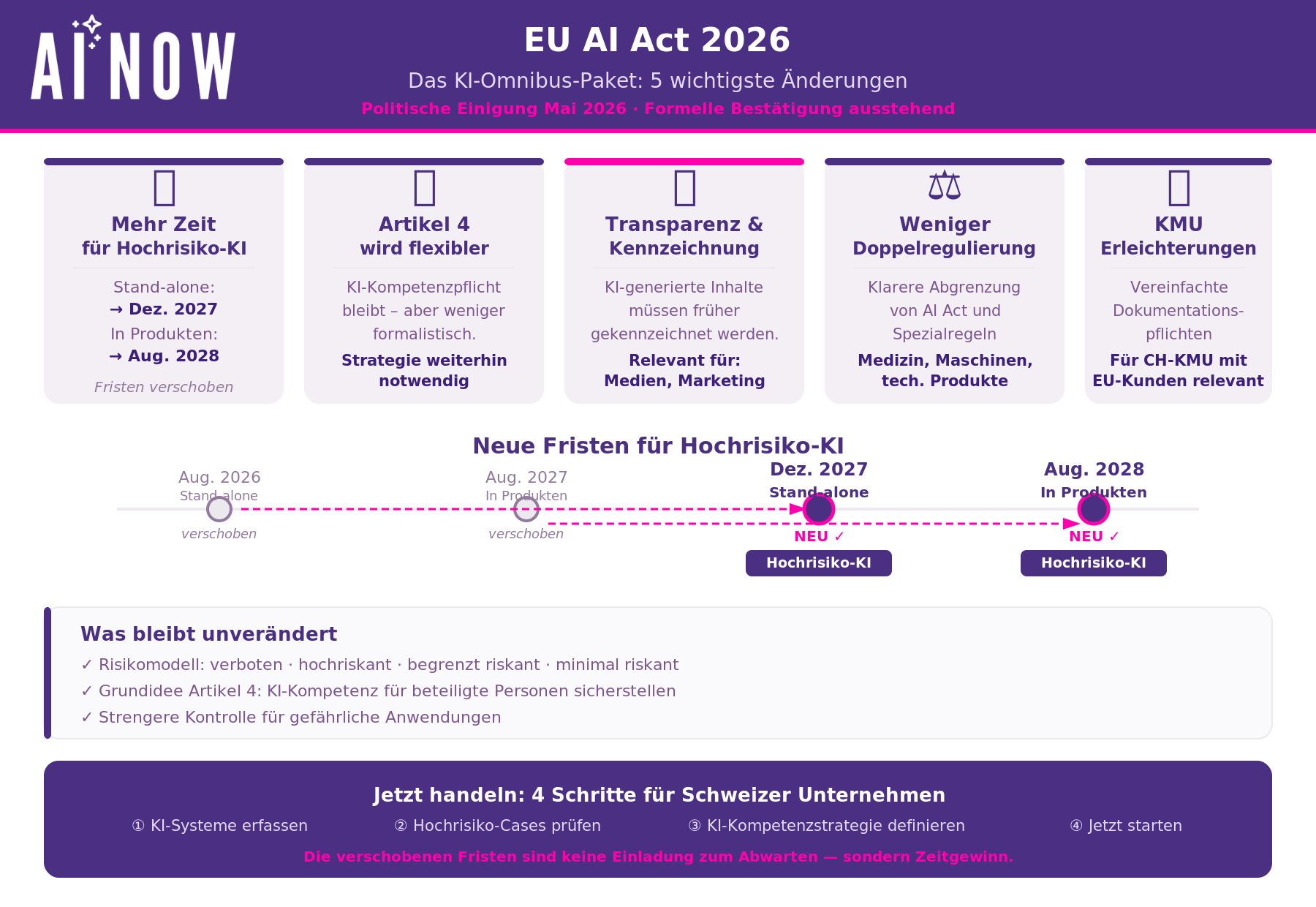
1. High-risk AI gets more time
The most important practical change concerns the deadlines for high-risk AI. For stand-alone high-risk systems, applicability is postponed from 2 August 2026 to 2 December 2027, and for high-risk AI in regulated products from 2 August 2027 to 2 August 2028.
This gives companies more time for technical documentation, risk management, conformity assessment and internal processes. But it does not mean that preparatory work should be postponed, because the requirements remain substantively in place.
2. Article 4 becomes more flexible
Article 4 of the AI Act obliges providers and deployers to take measures to ensure a sufficient level of AI literacy among their staff and other affected persons. As part of the Omnibus package, this obligation is formulated more flexibly: instead of a rigid duty to provide specific training or guarantee a fixed level of competence, the focus shifts to supportive measures and context-appropriate enablement.
In practice this means: the training obligation is not "obsolete", but it becomes less formalistic. Companies still need a coherent strategy for AI literacy, especially where employees develop, operate or use AI systems in critical processes.
3. Transparency rules and labelling
The transparency obligations of the AI Act remain in force, but are partly implemented more clearly in terms of timing and technology. In the Omnibus context, the focus is in particular on earlier labelling and technical marking of AI-generated content, in order to make manipulation and deception more difficult.
This is especially relevant for media, marketing, platforms and companies that integrate generative AI into customer-facing content. Anyone producing AI content should already establish processes for labelling, approval and internal control today.
4. Less double regulation
One goal of the package is to reduce overlaps with sectoral regulations. Particularly in machinery, medical devices and other regulated areas, it should become clearer which requirements come from the AI Act and which from specialised rules.
For manufacturers and providers in technically regulated markets this is a real advantage. Compliance does not become smaller, but it becomes easier to structure.
5. More room to manoeuvre for SMEs
Small and medium-sized enterprises should also benefit more from simplified requirements. This includes easements for documentation, scaling and in some cases evidence obligations.
For Swiss SMEs with EU customers this is particularly important. They can plan the upcoming requirements more realistically without having to deploy the same resources as large corporations.
What remains unchanged?
Despite the Omnibus, the core of the AI Act remains in place. The risk model with the levels prohibited, high-risk, limited-risk and minimal-risk continues to apply.
The basic idea of Article 4 also remains: anyone who uses AI must ensure that the people involved have sufficient understanding of risks, limitations and appropriate use. Likewise, the regulatory principle remains in place that particularly dangerous applications are controlled more strictly than everyday AI applications.
What does this mean for Swiss companies?
For Swiss companies, the topic is not theoretical. The Federal Council has announced that it will send a proposal on AI regulation into consultation by the end of 2026 and, in parallel, will promote non-binding measures such as industry solutions.
At the same time, the EU AI Act remains relevant for Swiss companies with EU exposure, for example when they offer AI systems in the EU, deploy them there or maintain customer relationships in the EU market. For such companies, it makes sense to inventory their own AI usage cleanly now, classify risks and define responsibilities.
What companies should do now
A pragmatic action plan looks like this:
Inventory all AI systems used in the company.
Check whether individual use cases fall into the high-risk category.
Define a role-based AI literacy strategy for employees who interact with AI.
Set up processes for transparency, documentation and approval of AI outputs.
Use the postponed deadlines as a time gain, not as an invitation to wait.
The last point in particular is decisive. The regulation does not become weaker in the sense of "irrelevant", but more precise and easier to implement.
Conclusion
The AI Omnibus package 2026 is not a winding-down of the EU AI Act, but a recalibration. The biggest effects are more time for high-risk AI, more flexible implementation of Article 4 and clearer boundaries in regulation.
For Swiss companies, the message is simple: anyone already using AI today should prepare in a structured way for the next requirements now. The best time to do this is not 2027 or 2028, but now.
FAQ on the AI Omnibus
Is the training obligation in the EU AI Act now abolished?
No. Article 4 remains in place, but its implementation becomes more flexible and less rigid.
Does the AI Act also apply to Swiss companies?
Directly only under certain constellations, but in practice very often when a company with EU exposure brings AI to the European market.
When do the new deadlines for high-risk AI apply?
For stand-alone high-risk systems from 2 December 2027 and for high-risk AI embedded in products from 2 August 2028.
What does this mean for SMEs?
SMEs gain more room to manoeuvre and partly simplified obligations, but must continue to systematically manage their AI usage.