Claude Code & Agent Teams: How AI Agents Are Revolutionizing the Workplace
Doris Margraf ·
Discover how Anthropic's Claude Code and autonomous agent teams are transforming the software market and what businesses need to do now.
The development of Artificial Intelligence has reached a critical turning point. While many still dismiss current advances as pure hype, the fundamental foundation of how we work is shifting right now. A single AI tool – Claude Code by Anthropic – has proven in record time that AI agents have reached production readiness.
At ainow.ch, we examine how this new technology works, why it is shaking financial markets, and how companies can deploy so-called agent teams in practice.
The AI Shock: Billions Lost on the Stock Market Through Autonomous Agents
The impact of autonomous AI systems is already measurable – on Wall Street. The introduction of Claude Code triggered a historic sell-off in software stocks at the end of January, destroying nearly $300 billion in value in a single day. The reason: the realization that expensive specialized software becomes obsolete when an AI can do the same work with open-source plugins.
Even more revealing was the subsequent crash in the cybersecurity sector. There, Claude Code wiped out another $15 billion in market value from industry giants like CrowdStrike and Cloudflare. The AI tool had managed to autonomously discover over 500 previously unknown security vulnerabilities in open-source projects, assess their severity, and immediately propose patches. These were vulnerabilities that human security experts had previously overlooked.
Are Programmers Obsolete? The Rapid Rise of AI Autonomy
To measure how capable AI agents truly are, the organization METR (Model Evaluation and Threat Research) uses the so-called Time Horizon Benchmark. This measures how long an agent can work autonomously on software tasks before requiring human assistance.
The development curve is breathtaking:
Late 2022 (ChatGPT): approx. 30 seconds of autonomous work capability.
November 2023 (Claude Opus 4.5): 320 minutes.
Today (Claude Opus 4.6): 870 minutes.
This represents a doubling of autonomous capability every four months. Projections suggest that by 2027, AI agents will be able to handle a complete 8-hour developer workday entirely on their own. Already today, Claude Code accounts for 4% of all public GitHub commits; experts forecast an increase to over 20% by the end of 2026.
Coding is considered "practically solved" in the industry. Since programming forms the foundation (and mathematics serves as the asymptote for all other capabilities), industries like law, finance, and data analytics will be revolutionized next.
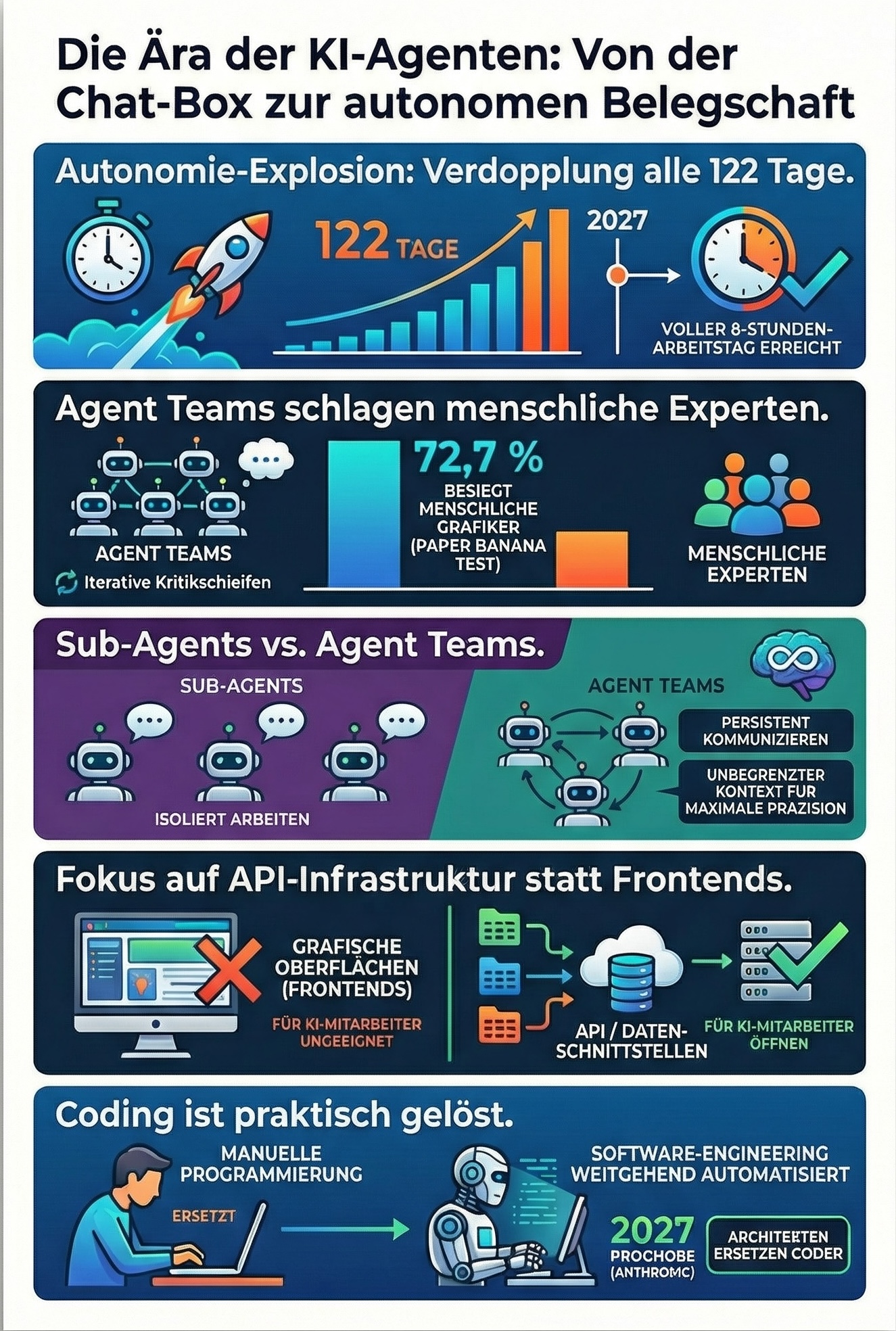
The Secret Behind the Performance: Subagents vs. Agent Teams
When AI models need to solve complex tasks in one go, they quickly hit the limits of their so-called context window (typically around 200,000 tokens). Once the context is full, the AI makes errors or forgets instructions. Anthropic solves this problem through strict context management in two expansion stages: Subagents and Agent Teams.
1. Subagents: Efficient Task Delegation
With subagents, a central lead agent controls the process from a single chat session. It delegates subtasks to subordinate subagents that work in parallel.
Each subagent receives its own fresh context window.
There is no communication between subagents.
Once the result is returned to the lead agent, the respective subagent (and its context) is deleted.
Advantage: The same task can theoretically be repeated indefinitely at consistently high quality without overloading the primary context window.
2. Agent Teams: The New Expansion Stage
With the update to Claude Opus 4.6, native agent teams were introduced. These are multiple separate Claude Code instances running in parallel.
Each agent has its own session and remains persistently active.
The team can communicate with each other. A lead agent provides tasks that team members independently pick up and work on collaboratively.
Best practice for cost reduction: The coordinating lead agent uses the powerful (but expensive) Opus 4.6 model on "Low Effort," while the executing team members run on the more efficient Sonnet model. Since agents don't inherit chat history, context must be deliberately injected through the initial prompt (the work instructions).
Case Study "Paper Banana": How AI Teams Beat Human Designers
How powerful communication within an agent team can be is demonstrated by a Google paper called "Paper Banana." It focused on creating scientific illustrations – a task where simple image generators had previously failed to match human quality.
Google built a pipeline of five agents that functioned like a small design agency: one agent for input, one for information retrieval, a planner, a designer, and – the crucial element – a critic. The designer created images, and the critic agent evaluated them iteratively across multiple loops.
The result: In a blind test, the AI agent team beat human experts in 72.7% of cases. Without the critic's iteration, the success rate was only 45.1%; after three feedback loops, it rose to over 60%.
This system can be directly replicated in Claude Code and adapted for marketing, design, or programming pipelines within your own organization. Successful workflows can then be permanently saved as a "Skill" in the workspace and recalled at any time via command.
The End of the User Interface and What Companies Must Do Now
This technological leap brings a profound change: the end of the traditional user interface (UI). AI agents don't live on beautiful dashboards – they work directly in the terminal (often monitored through tools like tmux) and communicate via APIs.
For businesses, this means the highest urgency. If your software infrastructure relies on manual clicks and doesn't offer clean interfaces (APIs) for AI agents, you'll fall behind. Competitors are connecting AI agents to their CRM or accounting systems in minutes because their systems are machine-readable.
Additionally, the integration of so-called open-weight models (open source) is becoming increasingly relevant. Four of the five most-used models by token consumption are already open source, as they can be hosted on proprietary infrastructure in compliance with EU regulations (GDPR) – a decisive factor for the European and Swiss market.
Conclusion: The Decade of Agents Has Begun
We stand at the beginning of the "Decade of Agents." The rule of thumb for the future is: anything you can teach a human employee through checklists and manuals on a screen can today be delegated to an AI agent – faster and more scalably.
Companies that fail to integrate these technologies (and the associated real-time knowledge exchange in "swarm intelligence") into their processes risk their very survival in the AI age.
AI now Supports Your Business
Want to deploy AI agents and agent teams in your organization? Our AI consulting helps you identify the right use cases and build the appropriate infrastructure. Or try our AI products like the aibox for a secure entry point.