AI Infrastructure 2026: Gigantism vs. Sovereignty
Jens Margraf ·
In the second week of February 2026, the global AI landscape is splitting more clearly than ever. While US hyperscalers are launching an unprecedented $650 billion offensive aimed at total market dominance, a sustainable counter-trend is emerging in Europe: a return to local control and specialized intelligence.
The $650 Billion Shock from Overseas
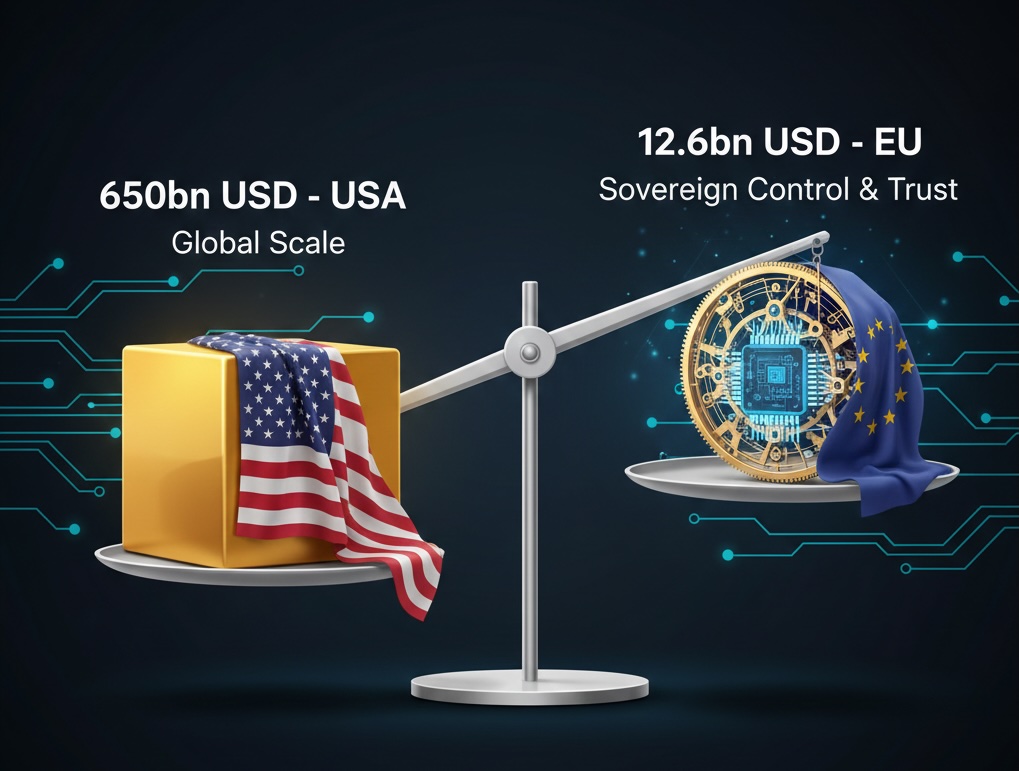
At the beginning of February 2026, Alphabet, Amazon, Meta, and Microsoft laid their cards on the table. With planned investments totaling approximately $650 billion for this year alone, the US tech giants are shattering all historical records. To put this in perspective: that is more than the entire US energy sector invests annually.
The goal behind this "all-in" bet is clear:
Infrastructure Monopoly: Those who own the most Blackwell GPUs and the largest data centers will dictate the rules of the next era.
Winner-Takes-All: The strategy aims to set global standards that create high switching costs for businesses (Vendor Lock-in).
Market Pressure: However, the sheer scale is causing jitters. Despite record spending, the tech giants' stock prices took a hit this week as investors began to question the short-term Return on Investment (ROI) of these massive "compute factories."
The European Counterpoint: Precision over Gigantism
While the US bets on mass, Europe is responding with a paradigm shift: Sovereign AI. The goal is not to build the largest model, but the most trustworthy one.
1. The "Sovereign AI Factory" as a New Standard A shining example of this sustainable trend is the opening of the new Sovereign AI Facility in Munich by Deutsche Telekom and Nvidia. This project isn't about global scaling; it’s about physical and legal security:
Data Geopatriation: Data never leaves the European legal jurisdiction.
Sustainable Cooling: Instead of massive energy waste, the facility utilizes local solutions like river water cooling—AI infrastructure in harmony with its local environment.
2. Specialization Beats Generalization Parallel to this, we are witnessing the rise of Domain-Specific Language Models (DSLMs). European industry is realizing that a model specialized in mechanical engineering or GDPR compliance is often more valuable than a US-based model that can write poetry but cannot safeguard trade secrets. These compact models run locally on a company’s own servers—the ultimate protection against a $650 billion cloud dependency.
Conclusion: Two Paths to the Future
We have reached a fork in the road. On one side is US Centralization, viewing AI as a global commodity like electricity or water—controlled by a handful of corporations. On the other side is European Sovereignty, viewing AI as a tool that must remain as close as possible to the user and their values.
Week 7 of 2026 has proven: true digital sovereignty is not won by regulation alone, but through independent infrastructure and the courage to specialize.